
How a Compact CO2 Condensing Unit Fits into a Larger Refrigeration Strategy
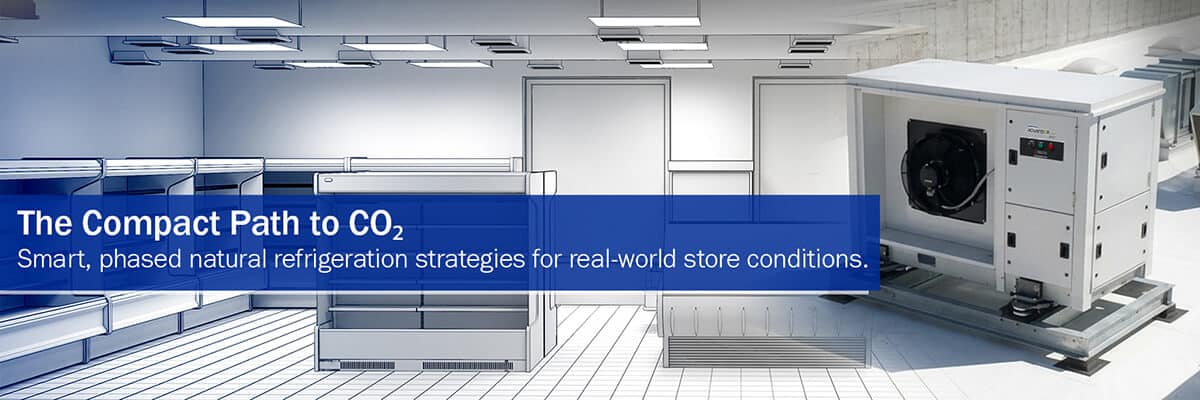
As more retailers evaluate how to modernize refrigeration, the conversation is shifting from theory to execution.
The question is no longer whether CO₂ has a place in the future of refrigeration, but how to apply it in ways that work for real store layouts, budgets and project timelines.
Most refrigeration upgrades do not start with a blank sheet of paper. They happen while stores operate, during phased capital cycles, in tight footprints, and under pressure to improve performance without unnecessary disruption. In that environment, compact CO₂ condensing units offer a practical and manageable path forward.
Matching the Refrigeration Solution to the Job
A smart refrigeration strategy starts with matching your equipment to your needs. Some projects justify a full, centralized architecture from day one. Others call for a more incremental approach that lets retailers meet immediate needs while preserving long-term flexibility.
Compact CO₂ condensing units are especially well suited for targeted applications such as:
- Walk-in coolers and freezers
- Targeted capacity additions
- Distributed refrigeration loads
- Phased store remodels
In these cases, the value is not simply a smaller unit. It is the ability to make the transition to natural refrigerants more practical from a technical, operational and financial standpoint.
Just as importantly, a compact CO₂ CDU is not always a stepping stone to something larger. In a small convenience store or other compact format, it can be the right long-term answer on its own.
In those settings, the CDU is not part of a future solution. It is the solution.
A Practical Bridge or a Complete Answer
Flexibility is what makes this category so valuable. In some stores, a compact CO₂ condensing unit supports a phased path toward a complete CO₂ refrigeration architecture. It can address targeted refrigeration loads today while keeping the site aligned with future expansion.
In other stores, especially smaller convenience formats, that same compact platform may be the final operating architecture. The right refrigeration strategy is not always simply choosing the biggest system. Sometimes, it is choosing the system that best fits the load, the space and the business model from the start.
That means compact CDUs can serve two roles equally well: a practical bridge for phased remodels or a complete destination solution when store size and application make them the smartest fit.
Built for Real-World Field Conditions
Refrigeration decisions today are shaped by more than cooling capacity alone. They are influenced by regulatory pressure, installation limitations, service access, uptime expectations and the need to protect capital planning.
This is where product design matters. A platform like Advansor FlexONE™ shows why.
Built as a compact CO₂ condensing unit with variable-speed operation, service-friendly access and high-ambient resilience, it reflects the kind of design thinking that fits real-world field deployment. Features like removable panels, organized piping, accessible service points and load-matching compressor control can help simplify commissioning, maintenance and long-term operation.
High-ambient performance also plays an important role. For retailers operating in demanding climates and outdoor conditions, a system designed to maintain stable cooling in extreme ambient temperatures adds confidence that compact design does not come at the expense of capability.
Flexibility Without Compromise
What makes this category compelling is not that it replaces every other refrigeration architecture. It does not. Larger centralized CO₂ systems still make sense in many applications and remain an important part of long-term store decarbonization strategies.
But not every project is ready for that step on day one, and not every store needs it at all.
In those cases, compact CO₂ condensing units give retailers a way to start where it makes sense for their stores, solve the loads in front of them and build toward a larger strategy over time, or fully solve the application with a right-sized standalone approach. That kind of flexibility is increasingly valuable in a market where modernization rarely happens all at once.
The Takeaway
The future of refrigeration will not be defined by a single system type. It will be shaped by solutions that help retailers move forward in practical steps.
For some stores, that will mean a centralized CO₂ architecture from the start. For others, it will mean beginning with a compact CO₂ condensing unit that addresses immediate needs while supporting a larger long-term plan. And for many small-format stores, a compact CO₂ CDU may be the long-term plan.
Seen that way, a compact CO₂ condensing unit is not a workaround or a compromise. It is a practical tool that can either enable a broader refrigeration strategy or stand as the best-fit end solution in its own right.

